Journalists, trauma and personal security
As a foreign correspondent, Sheila MacVicar (BJ鈥�77) covered it all 鈥� global tensions and terrorism, war crimes and regional strife.
Her journalism took her into troubled areas around the world, and earned her numerous accolades 鈥� among them, three Emmy Awards and a Peabody Award.
But at what price?

By Joseph Mathieu
Although their journalism can give voice to the voiceless, foreign correspondents often suffer their own afflictions in silence.
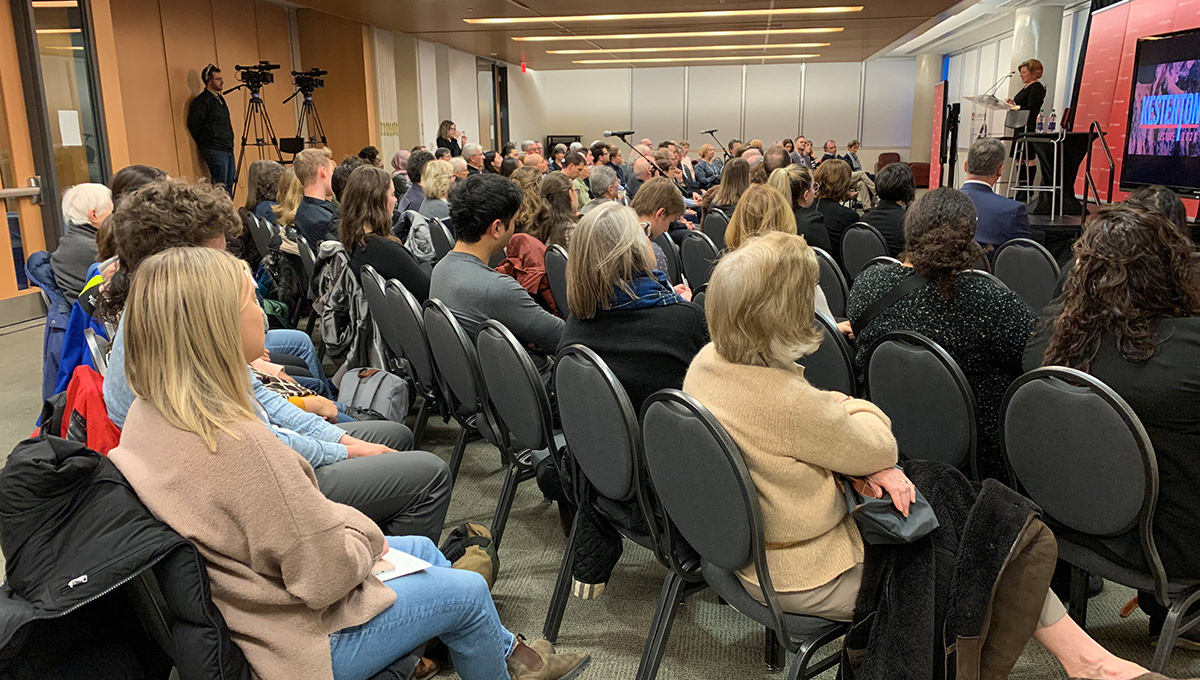
As she gave the 21st annual Kesterton Lecture on March 11, 2020, award-winning journalist Sheila MacVicar made a strong case for people in her profession to seek help for post-traumatic stress disorder (PTSD).
鈥淚 debated talking specifically about my own PTSD,鈥� she said. 鈥淏ut I think that this is a forum in which to speak openly, and if I鈥檓 advocating for greater openness it in fact becomes necessary.鈥�
After years of covering conflict and catastrophe around the world for ABC, CNN, CBS, CBC and Al Jazeera, MacVicar began to feel anxious and depressed. She had recurring nightmares and she became a nervous flyer.
鈥淚鈥檓 still not really comfortable with fireworks displays,鈥� she said. 鈥淚 hate anything that sounds like gunfire.鈥�
According to a study over 18 years by psychiatrist Anthony Feinstein, the long-term rate of full-on PTSD in war reporters approached that of combat veterans.
MacVicar never talked about these problems because of a mixture of fear, stigma and shame. She urged to a room full of colleagues and journalism students to fight those pressures and speak out.
鈥淚f you need help, do not be afraid to seek it. It is not weakness to acknowledge you need another tool in your toolbox.鈥�
As a budding journalist, MacVicar (BJ/77) was inspired by celebrated CBC foreign correspondent . Schlesinger covered many conflicts over 20 years, including the Vietnam War, the Iranian revolution, and the fall of the Berlin Wall. MacVicar remembered him regularly broadcasting his reports wearing a white trench coat.
When MacVicar became the first full-time female foreign correspondent at the CBC in the late 1980s, the profession was beginning to change.
鈥淔ar from that chic, white, globetrotting trench coat I envisaged,鈥� she said, 鈥渕ost of my foreign corresponding involved a sturdy pair of boots, a 10-plus kilo flak jacket permanently parked in my front hall, an extremely unflattering helmet, and most often an armoured car.鈥�
She described her 1992 arrival in Sarajevo: After a corkscrew descent to the airport in a C130 Hercules, she and her ABC news crew were instructed to run off the still-moving plane as it angled to take off immediately. They sped through sniper鈥檚 alley鈥攁 three-kilometre firing range for the Bosnian Serbs who besieged the city.
That night, MacVicar and her crew slept wearing flak jackets in the brutal Television Building. They eventually set up in the Sarajevo Holiday Inn, a war zone HQ for international reporters. The ideal stay was in a room where the windows had already been shot out, so guests no longer had to worry about glass shrapnel.
PTSD and bearing witness
Despite working in dire circumstances throughout her career, MacVicar said she was always aware of her privilege. She was there to bear witness and report back, but she was not trapped the way local civilians were.
鈥淲hatever I saw or witnessed, whatever horror or trauma I carried with me, those were very little compared to [what] the people lived through in those terrible points in their lives.鈥�
Even so, the things she saw, heard and felt in the Balkans, in Rwanda, and in numerous other conflicts began to take a toll. 鈥淚t adds up,鈥� said MacVicar.
PTSD is a response to actual or threatened injury, be it physical, emotional or psychological. What was known as 鈥渟hell shock鈥� during the First World War was reclassified as 鈥減ost-traumatic stress disorder鈥� by the American Psychiatric Association in 1980. The new term came with a better understanding of how trauma impacts the human psyche.
But stigma surrounding invisible injuries is still predominant today.

Trauma-informed journalism
MacVicar鈥檚 lecture was followed by a Q&A moderated by Matthew Pearson, a 杏吧原创 master of journalism graduate who is a reporter and associate producer for CBC.
Inspired and affected by the , Pearson wanted to help journalists better understand trauma and report traumatic news stories responsibly.
Thanks to a Michener-Deacon Fellowship for Journalism Education he received in 2017, he researched and created 鈥渢rauma-informed journalism鈥� modules. These instruct and help both journalists and newsrooms to better support colleagues suffering from trauma.
鈥淎s journalists, it falls on us to not look away,鈥� said Pearson. 鈥淗ow do we tell the story in a way that does justice to the person or people at the centre, and to our own mental and physical health?鈥�
Both Pearson and MacVicar emphasized the need for support from the organizations that send correspondents, producers and photographers to the front-lines.
鈥淲e need to work with employers to build on the work of those who have pioneered mental health care and journalism workplaces,鈥� said MacVicar.
鈥淲e need to include freelancers and local hires, and that includes drivers and translators who are too often left out of the equation. We need more capacity and resources.鈥�
When asked how she had motivated herself to get back into the field, MacVicar said she was part of a group of conflict reporters who were compelled to bear witness.
鈥淚t鈥檚 my job. It鈥檚 what I do. It鈥檚 the notion that I may be able to make a difference.鈥�
Kesterton’s key role
Named after Wilfred Kesterton, a media law and journalism history expert, the annual lecture celebrates journalism education and excellence in Canada.
The event is also part of the FPA Research Series, which highlights what the Faculty of Public Affairs does to address regional and global challenges.
Susan Harada, interim director of the School of Journalism and Communication and the program head of journalism, noted that Kesterton played a key role in establishing the school.
鈥淲ilfred Kesterton was our second full-time faculty member hired to teach journalism here some 70 years ago,鈥� said Harada.
鈥淭his lecture series pays tribute to Kesterton by bringing in people like Sheila MacVicar who can speak to the role of journalism in society today.鈥�


