Another factor in the decision to integrate Europe were the external pressures on Western European states immediately following the war. The United States and the Union of Soviet Socialist Republics (USSR) played important roles in creating an atmosphere where European integration could take place. Western Europe was now bordered by satellite states of the USSR and chose to rely heavily on the United States for security and aid.
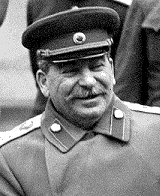
Soviet Leader Josef Stalin
The Cold War
The Cold War began almost immediately after the end of the Second World War. It was a conflict between the only two superpowers in the world, Soviet Russia and its satellite states and the United States and its allies. It was in many ways an ideological conflict between communist and capitalist countries which had an important impact on Europe.
Once the Allied Armies attacking from the West and the East defeated Germany, Europe was divided into spheres of influence with the Americans, British and French in Western Europe and the Soviets in Eastern Europe. Once Germany was defeated, a fault- line was created that split the European continent in half. In the East was the Soviet sphere of influence, comprising states such as Poland, Czechoslovakia and East Germany, while Western Europe was in the American sphere of influence.
The timeline below highlights key events after the end of World War II.
| A Brief Timeline of the Cold War in Europe | |
| 1945 | | Britain, the U.S., and the U.S.S.R. sign an agreement to create the United Nations. The Allies acknowledge the Soviet Union’s influence over Eastern Europe. |
| 1946 | Winston Churchill’s famous outlining the conflicts between liberal democracies and authoritarian communists. to listen to it. |
| 1947 | The Division of Germany In 1947, the U.S. and the U.S.S.R.聽reached an impasse concerning the future of Germany. Two separate states were created:
|
| 1948 |
The Communist takeover of Czechoslovakia |
| 1949 | The U.S.S.R. detonates its first atomic bomb. The is established. |
| 1953 | A occurs in East Berlin, resulting in over a million people protesting and rioting against the communist government across East Germany. Western countries did not step in to help the East Germans, further cementing the East-West divide. It is eventually suppressed by Soviet tanks. |
| 1956 | Popular unrest and discontent turns into a . Rebels declared Hungarian neutrality in the Cold War and appealed to the United Nations for help. It was eventually crushed by the Soviet military. |
| 1961 | Construction of the begins. The Wall became a symbol of the Iron Curtain in Europe because it was a physical barrier between communist East Berlin and capitalist West Berlin. Its purpose was to prevent East Germans from defecting to the West. Anyone caught trying to cross the barrier was imprisoned or killed. |
| 1962 | The brings the world to the brink of nuclear annihilation. The crisis occurred because the Soviet Union placed nuclear weapons on Cuba, extremely close to the United States mainland. However, after 13 days of tense negotiations, the Soviet Union agreed to remove the missiles if the United States promised not to invade Cuba, thus ending the crisis. |
| 1968 | The ,聽a period of reforms and democratization in Czechoslovakia under Alexander聽Dub膷ek, is abruptly ended by Soviet forces invading and occupying the country. Hard-line communists were put into key positions while Dub膷ek and his reforms were deposed. |
| 1979 | in order to support a communist government and prevent an anti-communist Muslim regime. The war would last until 1989 when the Soviet Union eventually pulled out of the conflict. The invasion was extremely unpopular both in the Soviet Union and around the world and led to . |
| 1985 | assumes power in the Soviet Union. He enacts reforms known as聽辫别谤别蝉迟谤辞颈办补听(“restructuring”) and聽glasnost (“openness”) which were aimed at modernizing the Soviet Union and allowing for more freedom and democracy in the country. He was a very popular leader in the West, where both United States President Ronald Reagan and United Kingdom Prime Minister Margarent Tatcher viewed Gorbachev as a man they could negotiate and do business with. |
| 1989 | After Hungary opens its western border with Austria, allowing for citizens of communist countries to escape to the West, the Berlin Wall finally falls. For the first time in 30 years, East Germans can freely travel to West Germany. Communist regimes fall in Poland, Hungary, and Czechoslovakia. |
| 1990 | |
| 1991 | One by one, states within the Soviet Union begin declaring independence. On December 25 and the country ceases to exist, thus ending the Cold War in Europe. |
Click here to proceed to Europe’s move towards integration.