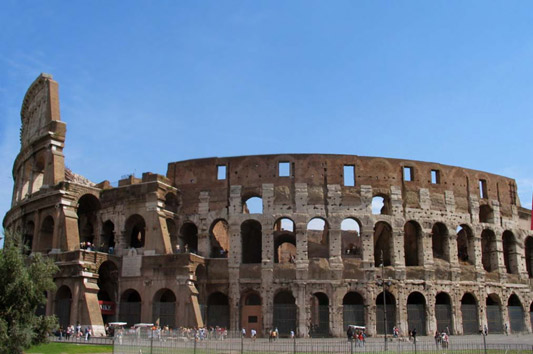
漏 Pictures of Rome courtesy of Rome.info
Italian is one of the Romance languages, having a common Latin ancestry with French, Spanish, Portuguese and Romanian. Looking at the Latin word for sun (solis), one can see the language similarities with soleil (French), sol (Spanish/Portuguese), soare (Romanian), and sole (Italian).
Italian is spoken by approximately 61.5 million people worldwide [1] and by 15% of the citizens of the European Union (fourth most commonly used after English, German and French) [2]. Inside the EU, Italian is an official language of Italy and Slovenia (regionally), but it is also used officially in Croatia (regionally), San Marino, Switzerland, and Vatican State [1]. In Canada, Italian is the mother tongue of 469 485 people, with 1.27 million identifying themselves as Italian [3].
Useful Expressions:
|
Hello
|
Ciao
|
|
Goodbye
|
Arrivederci
|
|
How are you?
|
Come sta? (informal)/Come va? (informal)
|
|
Excuse me/I’m sorry
|
Mi scusi/Mi dispiace
|
|
Do you speak English?
|
Parla inglese?
|
|
Yes/no
|
Si/no
|
|
Thank you
|
Grazie
|
|
My name is…
|
Mi chiamo…
|
|
I’m from Canada.
|
Sono canadese.
|
| I’m lost. Where is the nearest telephone/train station/hospital? |
Mi sono perso/a. Dove posso trovare un telefono qui vicino/una stazione ferroviaria qui vicina/ un ospedale qui vicino?
|
|
How much does it cost?
|
Quanto costa?
|
Language Resources:
Culture in italiano:
- Looking to build your Italian film collection? Visit for an extensive list and summaries of Italian classics (see The Bicycle Thief) and more recent films such as Life is Beautiful, Il Postino (The Postman) , or La Scorta (The Escort). Check out to see which foreign videos are available to rent online.
- Wondering what music’s on the Italian charts? Stop by (in Italian!) to see videos from Italian stars like Zero Assoluto, Anna Tatangelo, and Dolcenera.
- Italian food is so much more than East Side Mario’s. Check out for recipes and a pasta dictionary (all in English).
[1] Source: Gordon, Raymond G., Jr. (ed.), 2005. Ethnologue: Languages of the World, Fifteenth edition. Dallas, Tex.: SIL International. Online version:聽.
[2] Source: Eurobarometer: Europeans and Languages, Statistical Office of the European Communities in Luxembourg – September 2005.
[3]Source: Statistics Canada, 2001 Census: Population by mother tongue, by province and territory, and Population by selected ethnic origins, by province and territory.