How it all started for John Nater (BPAPM ’07)
“I bought all 300 or so hardbound copies of his Hansard for ten bucks,” Mr. Nater tells The Hill Times. “That was probably my first introduction to the procedure and practice side of things and I’ve just been interested in it ever since.”
His parents helped cart them home in the family pickup truck, and he’s still holding onto the ones in good condition.
Mr. Nater, now 33, says he’s been keen on government and politics for as long as he can remember, and after poring over the hundreds of pages of his auction find, his penchant for parliamentary procedure was solidified. He’s since went on to publish an academic paper on the evolution of the Thursday Question in 2014, and now has about two weeks of work left to complete his doctoral dissertation on government caucus meetings.
“I completely accept it as nerdy. I’ve always had an interest in government and politics,” says Mr. Nater, who before being elected in 2015, served on his local municipal council, worked as a public servant at the Treasury Board Secretariat and Correctional Service of Canada, and completed a master’s in public administration from Queen’s University.
Now, as the MP for Perth-Wellington, Ont., he’s been able to use his procedural chops to challenge the government’s usage and changes to the House rulebook, and to raise numerous points of order or questions of privilege with the House Speaker.

‘To actually be able to participate in that and potentially someday maybe be a footnote in one of the future editions of the House of Commons Procedure and Practice is a pretty honourable experience, something that is quite amazing for a farm boy from Logan Township to be part of,’ says John Nater. Photo courtesy John Nater.
“To actually be able to participate in that and potentially someday maybe be a footnote in one of the future editions of the House of Commons Procedure and Practice is a pretty honourable experience, something that is quite amazing for a farm boy from Logan Township to be part of,” he says.
Mr. Nater says he had considered running federally for a while, and when the time came for the riding’s nomination in 2014, the timing wasn’t ideal—his wife had just given birth six weeks earlier to their first child, Ainsley—but the two decided “there’s no perfect timing in life,” and so he filed his papers.
He won the rural riding with 42.9 per cent of the vote, or by 2,775 votes. Ainsley will be three at the end of the month, and they’ve since had a second child, Bennett, who just turned one.
While he’s finding it fascinating to get to be a part of the world he’d been reading about and observing for years, Mr. Nater says his schedule as an MP has put completing his PhD in political science from Western University on pause for now.
He’s been chipping away at it since 2009, and says he’s has about two weeks worth of work left to get his draft dissertation in shape to defend it.
“If I had two weeks of uninterrupted time I could probably finish … but the 2015 election came into play and I haven’t found that two weeks of time yet,” says Mr. Nater, adding that he’s told his wife Justine that he wants to get it done “sooner rather than later,” ideally, within this Parliament.
For his dissertation, Mr. Nater has spoken with cabinet ministers and MPs that were in government between 1984 and 2011—the Parliaments of Brian Mulroney, Jean Chrétien, Paul Martin, and Stephen Harper— about how government caucus meetings during those years were organized and operated, the influence individual Members of Parliament had, how issues were advanced, and examples of where the government’s policy direction changed as a result of concerns raised within caucus meetings.
For his 2014 study and report on the Thursday Question—the weekly post-Question Period time where the House leader for the official opposition asks the government House leader what will be on the agenda for the week following—Mr. Nater analyzed the 278 times a Thursday Question was asked between January 2001 of the 37th Parliament and September 2013 of the 41st Parliament, and found that it’s grown to be more of a long-winded political partisan tool than the original intent as a brief, direct, House management function. He presented his findings called: “It Being Thursday: The Weekly Business Statement in Minority and Majority Parliaments” at the Canadian Legal Sciences Association’s 2014 annual conference, at Brock University in St. Catharines, Ont.
“This is one aspect where there hasn’t been anything written on it in any great degree. It’s mentioned in O’Brien and Bosc, it’s mentioned in the procedure manuals, but there’s actually not any literature out there on it academically. So it was something that piqued my interest and spiked my curiosities,” says Mr. Nater.
As for his work in this Parliament, Mr. Nater has been able to use his procedural aptitude to raise a number of points of order or questions of privilege, including on the Thursday Question; over regarding relevancy of debate during Committee of the Whole; and on the appointment of the new clerk of the House of Commons.
He also played a prominent role at the opposition-spawned Procedure and House Affairs Committee filibuster in March over the government’s House rule changes. Over the 80 or so hours of the standoff at the committee, Mr. Nater made 122 interventions, according to the committee transcript. He enjoyed the experience so much he compared it to summer camp.
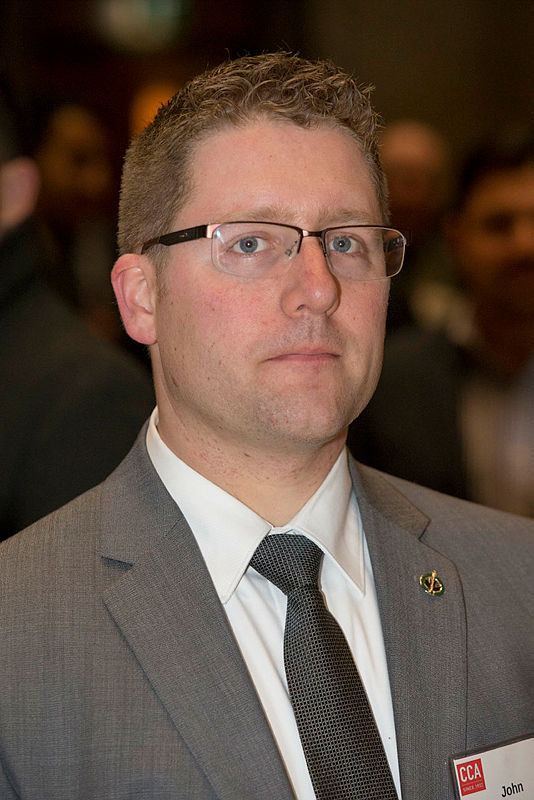
Conservative MP John Nater compared the multi-week PROC filibuster to ‘summer camp.’ The Hill Times photograph by Jake Wright
“That was kind of like summer camp for politicians in a way. It was quite the experience … some people saw it as a bit of a punishment or unfortunate duty, but I actually quite enjoyed that,” he says.
And his perspective on how the House of Commons is functioning procedurally so far in this Parliament? Mr. Nater says more could be done to better the overall workings that don’t require amendments to the Standing Orders, like more effective scheduling of votes, or optimistically, better collaboration between the three House leaders when it comes to setting the House agenda.
“We can always improve how we operate,” says Nater, who acknowledges it can be frustrating sometimes to see how things could be running smoother. He says based off of their use of procedural maneuvers, the Liberal government are coming off as novices when it comes to matters of the House.
“I think they are using checkers instead of chess,” says Nater.
He’s one of what’s likely just a handful of MPs that have read the often referenced O’Brien and Bosc—the latest edition of the House of Commons procedure and practice handbook, colloquially named after its editors, past House clerks Audrey O’Brien and Marc Bosc—in addition to other procedural manuals, like Arthur Beauchesne’s Parliamentary Rules and Forms of the House of Commons of Canada, but has yet to be offered a formal role amongst the Conservative House leadership team. For now he says he’s happy to offer his takes with colleagues in the opposition lobby or while walking the Centre Block corridors. He’s also the vice-chair of the House Official Languages Committee.
And even a procedural whiz like him is finding out new rules all the time, like, did you know you can’t use potatoes as props in the House?
“It seems silly, but it’s written down,” says Mr. Nater.